Best Winter Goggles for Extreme Carving
Nothing ends a good carving session faster than a goggle that fogs up mid-turn or a lens tint that turns flat light into a guessing game. We’ve cycled through more goggles than we can count chasing high-speed lines this winter, and the differences between a great pair and a mediocre one only show up once you’re actually leaned over at speed. Here’s what actually matters when you’re shopping.
Anti-Fog Technology Is Non-Negotiable
Fogging isn’t a minor annoyance at carving speeds — it’s a safety issue. The goggles that held up best in our testing used a double-lens construction with a sealed air gap, paired with a genuine anti-fog coating on the inner lens rather than a cheap spray-on treatment that wears off after a few cleanings.
Ventilation channels matter just as much as the coating itself. A goggle can have premium anti-fog treatment and still fog out if the foam venting is too restrictive or gets blocked by a helmet’s brim. We noticed the biggest difference between models when transitioning from a hard climb or lift line straight into a fast descent — that’s exactly when heat and moisture spike, and a poorly vented goggle simply can’t keep up.
Lens Tint and VLT: Match It to Your Conditions
VLT — visible light transmission — tells you roughly how much light a lens lets through, and it’s the single biggest factor in how well you’ll read terrain. In our editorial opinion, this is where most riders get it wrong by buying one lens and expecting it to work everywhere.
- Low VLT (dark) lenses: Best for bright bluebird days; brutal in flat light or storms
- Mid-range VLT lenses: The closest thing to an all-condition option, though never as sharp as a dedicated lens in either extreme
- High VLT (light/rose or yellow) lenses: Excellent for flat light and overcast carving, nearly unusable in full sun
If you’re serious about extreme carving across variable conditions, a quick-swap lens system is worth the extra cost. Being able to change tints between runs beats compromising with a single “do everything” lens every time.
Field of View Changes How You Read Terrain
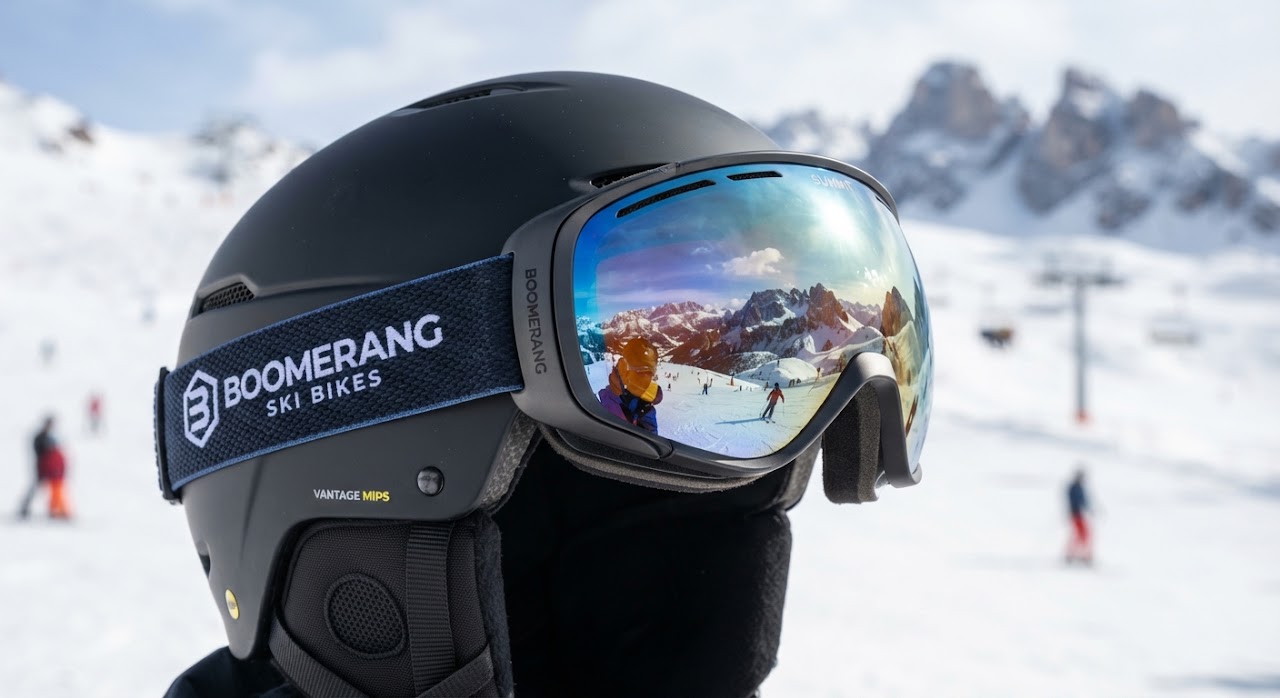
At speed, peripheral awareness is everything — you need to spot ruts, ice patches, and other riders well before you’re on top of them. The widest field-of-view goggles we tested used a cylindrical or spherical lens shape that curves away from the face, rather than a flatter lens that visibly narrows your side vision.
A goggle with a wide field of view doesn’t just look good — it buys you an extra half-second of reaction time on a fast carving line, and at speed, half a second is everything.
Fit With Your Helmet Matters More Than You Think
A goggle that’s excellent on its own can still be a disaster paired with the wrong helmet. Gaps between the goggle frame and helmet brim let in cold air and wind noise, while too tight a seal can create pressure points that distract you for an entire run. Always test the combination before committing — a goggle strap that clips cleanly to your specific helmet’s rear vents is a small detail that pays off constantly.
Our Pros and Cons Breakdown
- Pros of a premium anti-fog goggle: Reliable clarity across temperature swings, wider field of view, interchangeable lenses for variable conditions, better helmet integration
- Cons of a premium anti-fog goggle: Noticeably higher price point, lenses can be more fragile if not stored properly, replacement lenses add ongoing cost
- Pros of a budget goggle: Low upfront cost, fine for casual or occasional riders, easy to replace if scratched or lost
- Cons of a budget goggle: Fogs faster, narrower field of view, single fixed tint limits usable conditions
What We’d Actually Buy
For anyone carving hard and often, we lean toward a premium anti-fog goggle with a quick-swap lens system and a spherical shape — the wider view and condition flexibility are worth the added cost. Casual riders who stick to bluebird days and groomers can reasonably get away with a solid mid-range tint and skip the lens-swapping altogether.
The right goggle disappears on your face and lets you focus entirely on the line in front of you. Prioritize anti-fog performance and field of view first, dial in your tint for your typical conditions second, and never skip the helmet fit test — that’s the combination that actually holds up when you’re carving hard.